
 Setting a Goal to Change the World
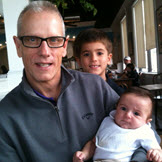 Jeff Carlisle’s booming career torpedoed in 2005 when Hurricane Katrina hit and ransacked New Orleans. The storm shuttered most of his clients’ businesses and forced Jeff to dissolve a partnership, close an office and rethink his career. It was not easy. He was 53 without work or a plan.
But with soul-searching and plenty of encouragement from family and friends, especially members of IARP, he decided to take the plunge and go out on his own. Carlisle Rehabilitation Services in Tampa will be 10 years old in November 2015, and its owner has never thought twice about his risky decision in the wake of disaster.
Jeff’s career path before the hurricane was not without minor storms and setbacks. But each was a growing experience that ultimately improved his life.
The very first turn came many years ago when, as an undergraduate at University of South Florida, he switched out of pre‐med. His decision to major in psychology came from a strong desire to do something meaningful that could change the world.
Getting to a place where he could make the changes he envisioned came with time and experience. Jeff’s first full‐time forays in the workforce became wake‐up calls that he needed more of both, time and experience, as well as a salary boost. After a short stint as an assistant in a mental health clinic and then as a parole officer in the Florida Probation and Parole Commission, he landed in rehabilitation work and found the connection he was looking for.
“The opportunity to work for Florida’s Department of Rehabilitation and Vocational Services just made sense to me,” said Jeff.
“It was a direct path to impacting people’s lives with re‐entry into the workplace,” he said, “the best of both worlds for clients and for me. The job offered a better wage and far more interesting work.”
His focus and workday ran the “gambit of disabilities,” he said. He learned about the value of education and on‐the‐job training as ways for his clients to rehabilitate. He learned his way around workman’s compensation so that his clients received the most benefit on their paths to recovery.
“My work at the department made me understand unique and individual approaches to re-‐employment based on a client’s particular disability.
“The other staff and I would coordinate medical care to maximize functioning for the client, and then we’d develop protocols – individual, written rehabilitation plans – for each client to follow.”
Jeff was hungry for more knowledge and enrolled at the University of South Florida at Tampa while still working in the department. In two years he had his masters in rehabilitation counseling, and before long landed a new job in the private sector at Intracorp where individualized client rehabilitation was foremost.
He stayed at Intracorp for 11 years and quickly moved up the ladder. By the time he was area director, his last post at the company, he was overseeing five offices and supervising 150 employees in three states -- Louisiana, Mississippi and Alabama. By then he and his family had moved from Tampa to New Orleans. His grown children remain in Louisiana today.
Despite the responsibility, all was not rosy for the man who was looking to change the world.
“As a manager at Intracorp I was not allowed to do casework, and I wanted to get back to it.” So he left to join Jennifer Palmer & Company, a private sector vocational rehabilitation firm based in New Orleans that gave him the varied and personal casework he enjoyed.
Eleven years later he and his wife returned to Florida to help out some aging parents, and Jennifer Palmer gave him and the other partners permission to open a branch in Tampa. It did well until Katrina forced its dissolution and left the four partners high and dry.
IARP influences in many directions
IARP played a critical role of getting Jeff “back in the swim” of successful career mode. In addition to the professional and personal friends who were members and told him to “put himself out there, don’t be afraid” (to launch a business), IARP leadership opportunities allowed him to stretch.
He took on multiple roles over time: the presidency of the Florida chapter twice (with a third time coming up later this year); the presidency of the Louisiana chapter, and the biggest one of all, president of IARP, which was called NARPPS when Jeff was at the helm.
“These were incredible experiences,” says Jeff. “IARP offered great opportunities to learn new skills and be exposed to different ways of looking at cases.”
The national post offered an exceptional challenge. As president of NARPPS, Jeff went to Capitol Hill to serve on a panel of experts that addressed Social Security reform before a subcommittee of the House of Representatives. The panel’s position: remove the barriers that prevent Social Security beneficiaries from returning to work.
“It was heady and nerve-‐wracking,” he said. “There were three lights that controlled the time: green, yellow and red. You knew you wanted to finish your comments before the red light came on. We barely made it through.”
As far as the panel’s success in influencing change in the SSA package? “Over time some of these obstacles have been removed,” said Jeff.
LEADERSHIP THROUGH IARP – CRC COMMISSION – A CHANCE TO GIVE BACK
His leadership success and commitment to professional growth opened more doors. Jeff took on the prestigious role as CRC Commissioner from July 1, 2001 to June 30, 2005 and served as chair of the Commission one more year, from July 1, 2005 to June 30, 2006.
“It required more effort, not another full‐time job but certainly close. But it was worth it.” As chair of the CRCC’s ethics committee – where he and other commissioners considered and dealt with ethical dilemmas and code violations that come with professional life – he produced quality work. As a result he was asked to serve on the task force for revision of the CRC Code of Ethics during its most recent refinement, which went into effect 2010.
“It was a tremendous opportunity to give back to the profession,” he said.
ADVICE: GET INVOLVED AND LEARN
To those just starting out or considering a career shift, Jeff’s advice is straightforward. “Don’t be afraid to admit what you don’t know and don’t be afraid to ask questions.
“Put yourself out there. Network with seasoned and newer professionals. Talking to other members you’ll be assured you’re not alone. These are peers to bounce ideas off of and to befriend.”
Finally, he advises to take advantage of the wealth of information within IARP. “Attend the national conference and talk to people. “
As for helping grow his business, Jeff says, “A week does not go by that I don’t talk with friends from IARP about work situations.” He finds similar value in the online discussion groups.
“Every day I look at the website and the discussions – SSVE and forensics coffee talk, for example -‐-‐ and I find good answers.”
Answers that very well may help Jeff change the world.