
 Going All Out, Connecting, Building a Career
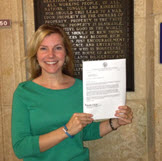 “I have set a pattern of going all-out all of the time,” said Elizabeth Skyles. “Now things keep finding me.”
The owner of Skyles Vocational Consulting LLC found the nerve to start her own business 11 years ago. She was in her late 20s.
In the beginning she stayed with her “day” job because she wasn’t sure about sole proprietorship, but when she finally threw herself into the business completely -- abandoning all other work -- her career exploded.
“It was so interesting to me,” says the woman who keeps her shelter rescue dog, Annie, close at hand, in the office and on the road. “Once I was able to pour my energy into my own business, work doubled quickly and kept increasing.”
She adds, “Referrals from insurance companies and attorneys were important to getting started and building a solid customer base.” These were the professionals she met early on -- in her first jobs and in the professional associations she joined.
The psychology major from the University of Missouri-Kansas City thought she wanted to be a doctor. But some mentoring from a university professor convinced her otherwise. She decided to stay in the health field but focus more on counseling.
“When I began searching for a master’s program I looked for one that would blend counseling, health and medicine. I found vocational rehabilitation counseling, and bingo!”
She enrolled in the University of Arkansas-Fayetteville masters of science in vocational rehabilitation counseling program, and though she enjoyed the curriculum, it was the internship she had at CorVel Corporation – and the business exposure it provided -- that completed the picture.
“I learned to incorporate business, counseling and medicine all in one, at the same time. I had found my niche.”
Interacting with attorneys, insurance companies and billing departments, Elizabeth began to see clearly how time equals money.
“Working at CorVel, I tried to keep the whole picture in mind – the client, the customer and the employer.”
After graduating with her master’s degree, Elizabeth moved to Illinois and continued to work for CorVel Corp. She chose the town of Forsyth, near Decatur, as her home because it is “charming and situated conveniently in the middle of the state, which made covering cases all over the state easier.” She continued to go all-out for the job.
“I felt as though the amount of learning and growth was multiplied because I was working independently, using all the skills from my education and internship, managing my time and creating relationships with attorneys and insurance companies. At the same time I was providing counseling, case management and consulting services to customers and clients.
“But it got to be too much.” Exhausted from extensive workweeks and driving long distances on a regular basis, Elizabeth left CorVel and worked for a year with developmentally disabled clients at Macon Resources, Inc., in Decatur.
“I was a case manager for people with developmental disabilities in a day program. The only goal was assisting clients to improve their skills, meeting their goals and living their best lives. It was a noncompetitive environment, and I worked with high school‐aged people to seniors, 60 years and older. It was what I needed to recharge my batteries.”
In 2004 she launched her business. She continued outside employment -- as a case manager at Macon County Health Department five days a week -- and building her business in every spare moment -- at night, on the weekends, in the car while driving to appointments, and on lunch breaks. Six years of double-‐duty!
“In the beginning there was considerable work to do to get the business up and running. In the middle there was more work because it was growing, and after a few years there was even more because I was handling two full-‐time jobs, never turning away work, and making plans to transition to my own business exclusively.
“It was hard!” says Elizabeth, her understatement palpable.
She credits the connections she made during the first few years of work at CorVel and the Macon County Health Department for ensuring her initial success at entrepreneurship.
“My professional contacts encouraged me to start my business, and my colleagues encouraged me to pursue my business goals. I was sought out for consulting services by insurance companies and attorneys.
“The constant flow of referrals along with personal determination and enthusiasm motivated me to continue,” she said.
Yet it took a while to have the confidence to leave the County job and work for her own business exclusively. In fact, she worked both full‐time jobs after she knew she had enough income to go it alone – for two more years!
ASSOCIATION WORK CREATES REFERENCES AND FRIENDSHIPS
Elizabeth, active in sports, clubs and organizations since childhood, recognized the value of associations and joined the National Rehabilitation Association (NRA) while pursuing her master’s degree at the University of Arkansas-‐Fayetteville. Her mentoring professor encouraged it, and she excelled right away, becoming president of the Student Rehabilitation Association at the university.
After a few years of living and working in Illinois, she joined the Illinois chapter of NRA (IRA) and soon joined its boards at regional and state levels. These positions gave her insight and exposure to the public sector, and her leadership roles continued.
“Once I began my business I was seeking further information, networking and education about vocational rehabilitation in the private sector.
“I found a division in NRA for private rehab called NASPPR. I was invited to join the NASPPR board and have continued to serve in various roles, including NASPPR president in 2014 and 2015 and NASPPR representative to the Rehabilitation Counseling Coalition (RCC),” she said.
In addition to serving NRA members in the private sector, NASPPR is a member of the RCC, along with IARP and several other rehabilitation organizations. Under Elizabeth’s leadership, NASPPR with other groups like IARP has brought critical matters to the attention of policy-‐makers on Capitol Hill -‐-‐ such as the importance of SSVEs and the renewal of the Blanket Purchase Agreement (BPA).
“In fact, I joined IARP because of a panel discussion at an NRA conference where IARP was represented by Steve Shedlin, who was president at that time,” she said. “Steve told me about IARP, invited me to join, and I signed up right away.”
Elizabeth went to the IARP annual conference in Puerto Rico a month later and was hooked. “I knew I had found the resources in IARP to help me continue to build my business and sharpen my professional skills. I’ve never looked back.”
In fact, she’s looking forward, wearing a new hat as an IARP-‐Illinois board member and running the IARP Emerging Professionals committee that helps practitioners newer to the profession take advantage of IARP’s multiple resources.
“I readily remember the uncertainties of being an emerging professional, and I want to help emerging professionals in IARP who are experiencing that stage of their careers. I have great interest and information to share about how to start your own business.
“It’s a collaborative venture, and IARP is very interested in meeting the needs of students and emerging professionals in the organization.”
ADVICE TO ENTREPRENEURS: DO YOUR HOMEWORK
As for Elizabeth’s advice to someone contemplating a business launch: Do your homework.
“First be employed by a company that does private rehabilitation,” she says. “The exposure and experience are invaluable. Then identify your professional strengths and interests and match those with services needed in your area.”
ANTICIPATE DELAYED GRATIFICATION
“Be prepared to contend with the idea of delayed gratification,” she says. “It takes patience and perseverance to get a business going. Stay focused and passionate about your goals because if you’re not everything can get in the way and sap your energy.”
KEEP YOUR EYES OPEN FOR OPPORTUNITY
Although she has developed a great life in Forsyth, Ill., with a robust network of contacts in the state, Elizabeth recognizes she could relocate some day.
“IARP is a valuable resource providing feedback, opportunities to learn, grow and network. If I wanted or needed to move I would have opportunities in other states because of IARP and the friendships I have formed throughout the country.
“And,” she says, in answer to the query of why she is so involved now in IARP and other organizations, “I give back because I have gained so much!”
Going all-out to give back, that’s Elizabeth Skyles’ signature style.